Organizations rely on data to support everything from customer engagement and sales to marketing, compliance, fraud prevention, and strategic planning. As businesses collect information from websites, customer relationship management (CRM) systems, applications, third-party providers, and internal databases, maintaining high-quality data becomes increasingly important.
Data quality management is the ongoing process of ensuring that information remains accurate, complete, consistent, timely, and reliable throughout its lifecycle. Organizations that prioritize data quality are better positioned to improve operational efficiency, strengthen analytics, support informed business decisions, and deliver better customer experiences.
Platforms like Enformion help organizations strengthen their data quality management strategies by providing real-time access to identity, people, business, asset, and court record data through both self-service searches and API integrations. When integrated into existing workflows, trusted data sources can help organizations maintain more complete and dependable records while improving overall business intelligence.
Data quality management (DQM) refers to the policies, processes, technologies, and governance practices used to ensure organizational data remains accurate, reliable, and fit for business use.
Rather than focusing solely on correcting errors after they occur, data quality management emphasizes continuously monitoring and improving data throughout its entire lifecycle—from collection and validation to storage, maintenance, enrichment, and ongoing governance.
High-quality data generally shares several characteristics:
• Accuracy
• Completeness
• Consistency
• Timeliness
• Validity
• Uniqueness
• Reliability
These attributes help organizations establish confidence in the information used across departments and business applications.
Reliable data supports nearly every aspect of modern business operations. Sales teams depend on accurate contact information, marketing teams rely on clean audience segments, compliance professionals require verified records, and executives use trusted analytics to guide strategic initiatives.
Poor-quality data can introduce inefficiencies, duplicate work, and inconsistent reporting. By contrast, organizations that invest in strong data quality management create a stronger foundation for sustainable growth.
High-quality data can help organizations:
• Improve customer relationship management
• Strengthen marketing segmentation
• Increase operational efficiency
• Support fraud prevention initiatives
• Enhance business reporting
• Improve workflow automation
• Maintain more reliable analytics
• Build greater confidence in organizational decision support
As businesses expand, maintaining trusted data becomes increasingly valuable across multiple teams.
Successful data quality management combines technology, governance, standardized processes, and ongoing monitoring. The following best practices can help organizations establish a stronger data foundation.
Consistency begins with clearly defined standards.
Organizations should determine how information is collected, formatted, validated, stored, and maintained across all systems. Standardization reduces inconsistencies that often occur when multiple departments collect information differently.
Examples include:
• Standardized address formatting
• Consistent naming conventions
• Uniform date formats
• Required data fields
• Accepted value lists
• Business-specific validation rules
Documented standards help improve data consistency throughout the organization.
Preventing inaccurate information from entering systems is often more effective than correcting errors later.
Organizations can improve data quality by validating information during collection using automated rules that verify required fields, acceptable formats, and logical consistency.
Common validation practices include:
• Email format verification
• Phone number formatting
• Address standardization
• Duplicate detection
• Required field validation
• Business rule enforcement
Early validation helps reduce downstream cleanup efforts while improving overall record quality.
Duplicate records create confusion across customer databases, sales systems, and operational workflows.
Organizations should regularly identify and merge duplicate entries using matching rules based on names, contact information, business identifiers, or other unique attributes.
Reducing duplication helps create a more complete and accurate view of customers, businesses, and other entities while improving reporting accuracy.
Data quality is not a one-time project.
Organizations benefit from scheduled audits that identify incomplete records, outdated information, inconsistencies, and anomalies before they affect business operations.
Key performance indicators (KPIs) often include:
• Duplicate record rate
• Missing required fields
• Data completeness percentage
• Accuracy scores
• Record freshness
• Validation success rates
Ongoing monitoring allows organizations to measure improvement over time.
Effective data quality management depends on strong governance.
Data governance establishes ownership, accountability, policies, and procedures that define how information is managed throughout the organization.
Successful governance programs typically include:
• Clearly defined data owners
• Documented quality standards
• Security and privacy policies
• Data lifecycle management
• Regular compliance reviews
• Change management processes
When governance supports quality initiatives, organizations create more consistent and trustworthy datasets.
Organizations often possess valuable customer and business records that could become even more useful with additional context.
Data enrichment supplements existing information with verified external data that improves completeness and accuracy.
Examples of enrichment include:
• Updated contact information
• Additional identity attributes
• Business information
• Asset-related records
• Court record information
• Address updates
• Entity relationships
Real-time enrichment allows organizations to maintain more current information without relying solely on historical records.
Solutions such as Enformion enable organizations to enrich existing records using real-time access to extensive identity, people, business, asset, and court record data through flexible search tools and API integrations. By incorporating trusted external information into existing workflows, organizations can improve record quality while supporting a variety of operational and analytical use cases.
Business data changes constantly.
Customers relocate, businesses update information, assets change ownership, and contact information evolves over time. Continuous monitoring helps ensure organizational records remain current.
Organizations can automate monitoring through:
• Scheduled validation processes
• Quality dashboards
• Exception reporting
• Automated alerts
• Periodic record verification
• Integration monitoring
Continuous oversight helps identify issues early while supporting long-term data reliability.
Data quality is a shared responsibility.
Marketing, sales, customer service, operations, compliance, finance, and IT often contribute to the same datasets. Cross-functional collaboration helps establish common standards while reducing inconsistencies across systems.
Organizations often benefit from:
• Shared governance committees
• Common data definitions
• Organization-wide quality metrics
• Cross-functional training
• Regular process reviews
Collaborative approaches help ensure that quality improvements extend across the entire business.
Manual data management becomes increasingly difficult as organizations grow.
Automation helps streamline repetitive quality tasks while improving consistency.
Examples include:
• Automated validation
• Duplicate detection
• Record matching
• Standardization
• Scheduled quality reporting
• Workflow integrations
Automated processes allow teams to spend less time correcting data and more time using reliable information to support business objectives.
Continuous improvement depends on measurable results.
Organizations should establish benchmarks and monitor key metrics that reflect overall data health.
Common metrics include:
• Data accuracy rate
• Duplicate percentage
• Completeness score
• Record update frequency
• Validation pass rate
• Data consistency score
• Time required to resolve quality issues
Tracking these metrics helps organizations evaluate the effectiveness of their data quality management initiatives while identifying new opportunities for optimization.
Organizations seeking to improve data quality often benefit from combining internal information with trusted external data sources.
Enformion provides real-time access to identity, people, business, asset, and court record data through intuitive self-service searches and API integrations. These capabilities can support data validation, record enrichment, identity research, business intelligence, fraud risk workflows, customer information management, and operational efficiency.
Because Enformion delivers current information directly into existing workflows, organizations can strengthen their overall data quality management strategy while reducing manual research and improving the completeness of their records. As part of a broader data management approach, integrating trusted external data can help teams maintain more accurate and reliable information that supports long-term growth.
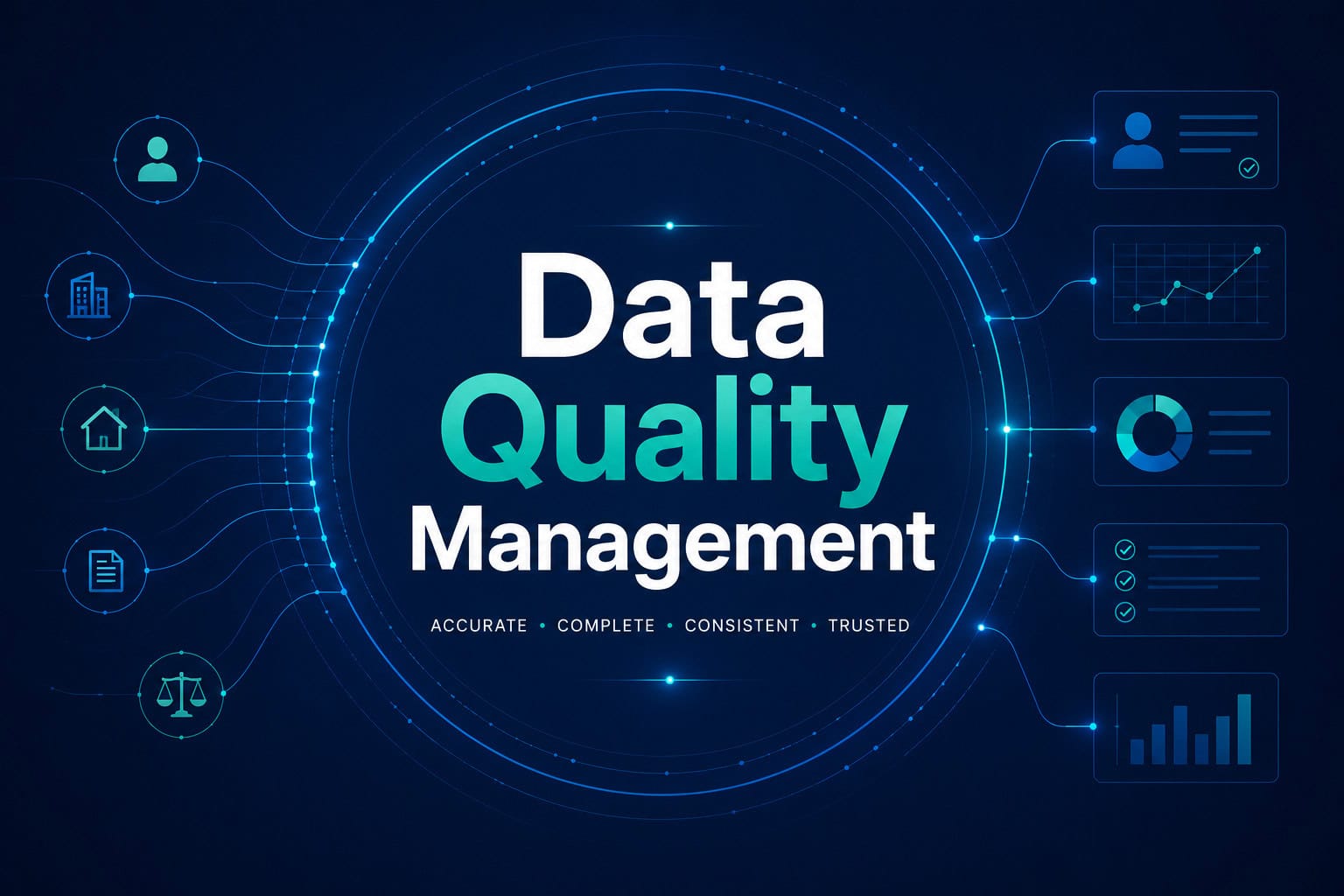
Strong data quality management provides the foundation for more reliable operations, improved customer insights, and better organizational performance. By establishing clear governance, validating information at collection, eliminating duplicate records, enriching existing data, and continuously monitoring quality, organizations can build data assets that remain valuable over time.
If your organization is looking to strengthen its data quality management strategy with real-time identity, people, business, asset, and court record intelligence, request a demo to learn how Enformion can help support cleaner, more complete, and more reliable business data through flexible self-service searches and API integrations.