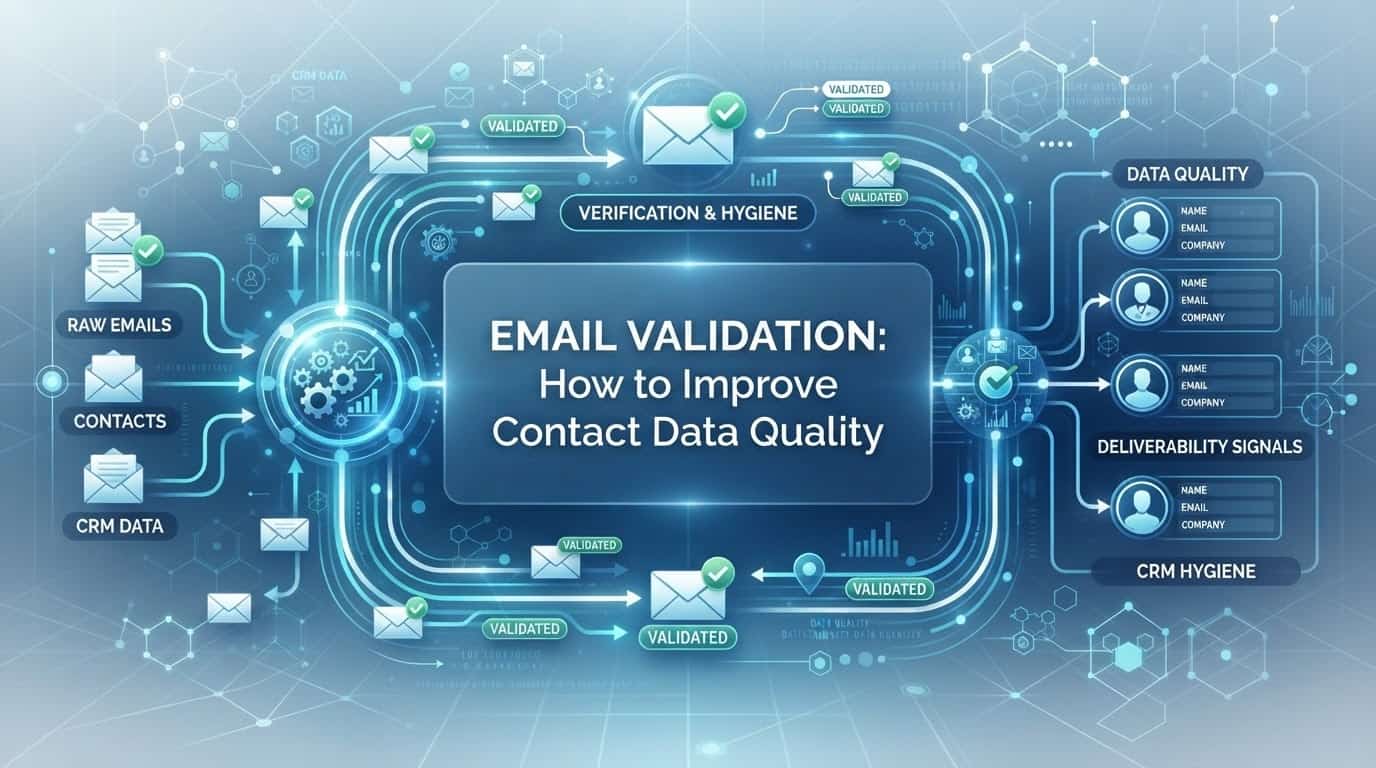
Email is often the fastest way to reach a customer, prospect, or lead, but it is also one of the easiest fields for a CRM to get wrong. A single typo can create a hard bounce. A role-based inbox may not represent the person your team is trying to engage. A stale business address may remain in a database long after a contact changes companies. When email data is unreliable, contact records become harder to trust and campaigns become harder to measure.
Email validation helps improve contact data quality by checking whether email addresses are properly formatted, usable, and appropriate for the workflow they support. It is not a cure for every CRM problem, and it should not be treated as proof that a person is engaged or ready to buy. But when used alongside broader data hygiene, identity resolution, and contact enrichment, email validation can help teams reduce waste, protect sender reputation, and build cleaner customer records.
Email validation is the process of evaluating an email address before it is used in outreach, analytics, enrichment, or CRM workflows. The simplest checks look at syntax: whether the address contains the expected structure, whether the domain is present, and whether obvious formatting errors are present. More advanced checks may evaluate domain existence, mail server configuration, disposable-domain patterns, role-based inboxes, and signals that an address may be undeliverable or risky for a particular outreach program.
Validation should be understood as a confidence signal, not a guarantee. A valid-looking email can still belong to the wrong record, become inactive later, or fail because of server rules outside the sender’s control. That is why email validation works best as one layer in a broader contact data quality program.
For organizations improving customer profiles, Enformion’s Contact Enrichment capabilities support cleaner, more complete records by helping teams refresh and enrich verified contact information.
Email addresses influence many parts of the customer data lifecycle. They are used for lead capture, account creation, customer service, campaign segmentation, newsletter delivery, suppression lists, and data matching. When email fields are inaccurate, teams may create duplicate records, misattribute engagement, waste outreach, or make poor decisions from incomplete data.
Cleaner email data can help teams:
Email quality is closely connected to overall customer data management. Enformion’s article on how data validation enhances sales campaign accuracy explains why outreach performance depends on accurate, complete, and current customer and prospect information.
Bad email data rarely comes from one source. It accumulates through normal business processes, especially when teams collect records from multiple systems and channels. A prospect may mistype an address on a form. A sales representative may enter an address from a business card. A purchased or partner-provided list may contain old professional emails. A CRM migration may preserve records that have not been checked in years.
Common email data problems include:
Validation helps identify many of these issues, but governance decides what happens next. Some addresses should be corrected. Some should be suppressed from campaign use. Others may need enrichment, manual review, or a different contact method.
Email validation answers one important question: is this email field usable enough for the next step? Contact enrichment asks a broader question: what additional verified information would make this customer record more complete and actionable? The two processes reinforce each other when they are sequenced carefully.
For example, a CRM record with a name and email address may be difficult to match confidently if the email is invalid or outdated. Validating the email first can improve confidence before enrichment appends additional contact details, address context, business information, or segmentation attributes. Conversely, enrichment may help teams identify a better current contact point when an existing email is no longer reliable.
Enformion’s Sales Enablement and Marketing Intelligence solutions are built for teams working to improve first-party data, customer profiles, lead quality, and audience intelligence.
Email validation can happen in real time or in batches. Real-time validation is useful when a record enters the system through a form, onboarding workflow, sales entry, or integration. It helps prevent obvious errors before they become part of a CRM, marketing automation platform, or customer data warehouse.
Batch validation is better suited for existing databases. Teams may run scheduled reviews before a major campaign, after a CRM migration, during a data-quality audit, or before contact enrichment. Batch processing helps uncover stale records and source-specific quality issues that may not be visible record by record. Enformion’s data delivery options give organizations flexibility to support both integrated and file-based data workflows.
Email validation should be part of a repeatable data-quality process rather than a one-time cleanup. The strongest programs combine automation, governance, and measurement so teams know which records are trustworthy and which need review.
These practices help teams move from reactive cleanup to ongoing data stewardship. Instead of waiting for a campaign to reveal poor data quality through bounces and low engagement, teams can improve records before they are used.
The value of email validation should be measured through practical operational metrics. Useful indicators include hard bounce rate, invalid-email rate by source, duplicate rate, missing-email rate, match rate, campaign suppression volume, delivery performance, and the percentage of records refreshed within a defined time period. No single metric proves contact data quality, but together they show whether the CRM is becoming more reliable.
Measurement also helps prioritize effort. If one lead source consistently produces invalid or disposable emails, the team can investigate that source. If older customer segments show higher stale-email rates, the team can schedule more frequent refreshes. If enriched records show better contactability than unenriched records, the business has evidence to refine its data-quality workflow.
Email validation improves contact data quality by identifying errors earlier, supporting cleaner CRM records, and giving sales and marketing teams more confidence in the data they use. It works best when paired with deduplication, enrichment, governance, and regular refresh cycles that keep customer records useful over time.
If your team is working to strengthen CRM hygiene, contact enrichment, or sales and marketing data workflows, request a demo to learn how Enformion can help support cleaner, more actionable customer intelligence.